Stories
Empathy Museum
Other Initiatives
Credits
About
Developing the ability to understand the realities and points of view of people we don’t know is essential to recognizing and respecting differences, overcoming conflicts, and imagining new collective worlds.
“A Mile in My Shoes” offers a personal experience that stimulates empathy and awareness of contemporary social issues, encouraging a shift in mindset toward a fairer, more compassionate, and sustainable culture.
Inspired by the Native American proverb, “You can’t judge another person until you’ve walked a mile in their shoes,” the installation invites visitors to literally step into someone else’s shoes and walk while listening to a fragment of their life story. The installation is part of the Empathy Museum, an international project based in London that, since 2015, has collected more than 400 stories across 14 countries.
For the COP30 edition, produced by Intercultura, new stories were collected from people living in the Amazon — men and women from Indigenous, riverside, quilombola, rural, and urban communities. Many realities, many Amazons, many connections with nature, many challenges. Stories from the Empathy Museum’s own collection also feature voices of people who live in special ways in relation to the natural world.
As Roman Krznaric says, “Empathy has the power not only to transform our own lives, but also to bring about profound social change. Empathy can start a revolution.” And that is precisely what we need to face the challenges of the contemporary world.
The Empathy Museum
Empathy Museum is a series of art projects dedicated to helping us look at the world through other people’s eyes and explores how empathy can not only transform our personal relationships, but also help tackle global challenges such as prejudice, conflict and inequality.
Empathy Museum was founded by philosopher/writer Roman Krznaric and is led by artist Clare Patey. The project was created in response to declining levels of empathy worldwide and to the changing nature of the British High Street.
Each of our projects is built around the form of a shop, re-imagined as a space for dialogue, human exchange and community building, rather than purely commercial transaction.
Other Initiatives
“A Mile in My Shoes” in Ibirapuera
The installation “A Mile in My Shoes” was presented in Brazil in two public spaces through a partnership between Intercultura and the Empathy Museum.
The scenography — a large shoebox — displays a collection of individual boxes, each containing a pair of shoes and a headset with the owner’s recorded story, to be listened to during a 10-minute walk.
The collection includes stories from people of different ages, genders, and social backgrounds who share personal challenges: a young man with ADHD, the father of a transgender daughter, a woman facing fatphobia, a blind librarian.
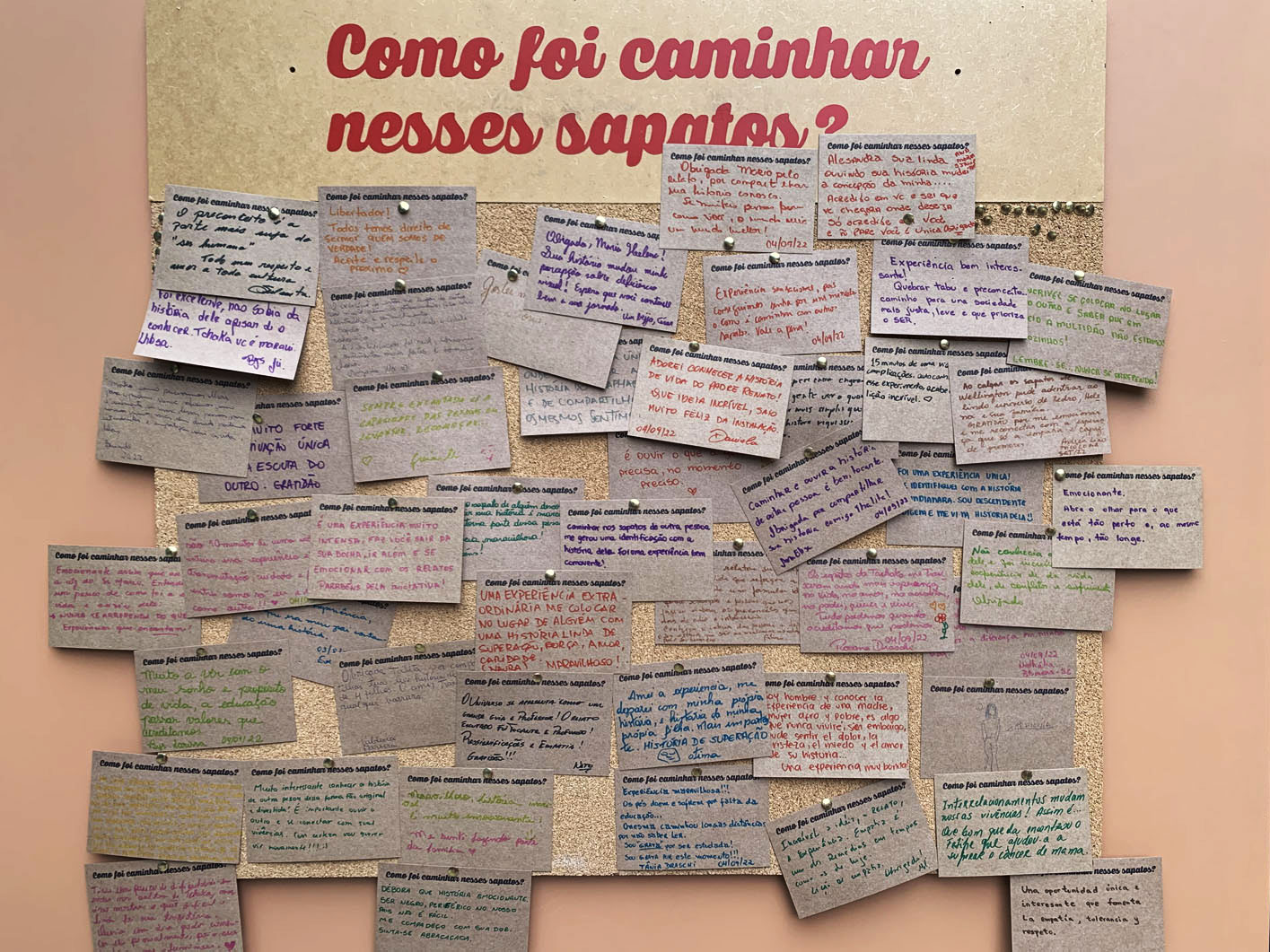
Each story is a journey into a very special world where we encounter others — and ourselves — in a genuine way. Nearly 15,000 people took part in the two installations. (watch the video here)
The Empathy Journey
The Empathy Journey was an online cultural experience designed to awaken empathy within each of us.
It encouraged moments of stepping outside our usual perspectives and connecting with others, strengthening respect and recognition of multiple identities and cultures while raising awareness of social inequalities in Brazilian society.
The three-day program featured a special lineup curated collaboratively by researchers and cultural practitioners — life stories from people of diverse backgrounds, empathy-based practices, artistic experiences, projects, and thought-provoking conversations.
Empathy at Schools
Intercultura also developed a traveling version of “A Mile in My Shoes”, which since 2022 has been brought to high schools across São Paulo.
More than 12,000 students from 26 schools have already participated in the experience. For schools, the project plays a key role in strengthening civic education by fostering recognition and respect for diversity.
It also serves as an effective tool for addressing violence within schools — from bullying to building greater trust within the school community — which is essential for a constructive and meaningful educational environment.